Sunday, June 10, 2018

The Foolish Sage

Once upon a time, there was a sage called Deva Sharma who lived in a temple in the outskirts of a town.


The Foolish Sage - Panchatantra Story Picture
He was widely known and respected. People would visit him, and offer him with gifts, food, money and garments to seek his blessings. The gifts that he did not need for himself, he would sell off, and got rich on the proceeds.

And by nature, he trusted nobody.

He never trusted anybody. So, he kept all his money in a bag which he carried under his arm all the time. He would not part with the bag for a single moment.

One day, a swindler came across the sage, and he became sure that the bag this holy man was so possessive of, must surely contain a lot of treasure.

He planned on stealing the bag from the sage, but could not think of a way to do so. He thought, "I cannot make a hole in the temple wall, or jump over the high gates. But I can charm him with sweet words to accept me as his disciple."

The Foolish Sage - Panchatantra Story Picture
He wondered, "If I can stay with him as a disciple, I can win his confidence. When I get an opportunity, I will rob him, and leave this place."

Having planned so, the swindler approached the holy man with reverence, "Om Namah Shivaya! (I bow before Lord Shiva, the God of Destruction)"

With these words, he fell on the sage's feet and said, "O Guruji, Please guide me to the right path of life. I am fed-up with life, and want to seek peace."

The sage kindly replied, "My son, I will surely guide you. You are blessed because you have come to me to seek peace at this young age".

The Foolish Sage - Panchatantra Story Picture
This was the opportunity the swindler was seeking, and he at once touched the feet of the sage for blessings, "O Guruji, please accept me as your disciple. I will do whatever you ask me to do."

The sage accepted the swindler as his disciple, but only on a condition. He said, "A holy man as me is recommended to spend the night alone without company. This helps me to meditate also. So, you will not be allowed to enter the temple at night. You will sleep in a hut at the gate of the temple."

The swindler agreed, "I shall willingly serve your wishes in every way that you ask me to."

In the evening, the sage initiated the rituals and formally took the swindler as his disciple.

The swindler in return proved himself an obedient disciple. He massaged his hands and feet, washed his feet, and helped him with all the rituals along with cleaning the temple. Although the sage was happy with his disciple, the swindler could not gain enough confidence for the sage to part with his bag when he was around.

As days passed by, the swindler started getting frustrated, "He does not trust me enough to leave the bag with me. I can gain access to the bag if I kill him with a knife or feed him with poison."

When he was thinking all this, the swindler saw a young boy visit the sage. He was the son of one of the sage's followers. He invited the sage, "O Guruji, I have come here personally to invite you to our house for the ceremony of sacred thread. Please accept the invitation to sanctify the ceremony with your kind presence."

The Foolish Sage - Panchatantra Story Picture
The sage accepted the invitation, and after some time started off for the town with the swindler. On the way, they came across a river, where the sage thought of relieving himself. He folded the bagful of money in his robe. He asked his disciple to look after it, "My child, Look after the robe until I return".

This was the opportunity that the swindler was seeking all the while. As soon as the sage went behind the bushes, the swindler ran away with the bagful of money.

When the sage returned, he did not find the disciple around but found his robe lying on the ground. Shocked and anxious, he peered inside only to find his bag of money was gone.

The Foolish Sage - Panchatantra Story Picture
At once he knew what had happened, and began to shout, "Oh. Where are you, you rascal. You have robbed me."

The sage then started trailing the swindler's footsteps, but he reached town. He knew he will not be able to catch hold of him. He stayed the night in town to return empty-handed to his temple next morning.


The wise indeed say:
Do not be taken in by the sweet words of a swindler.


The Fall and Rise of a Merchant

In a city called Vardhamana, lived a very efficient and prosperous merchant.


The Fall And Rise of A Merchant - Panchatantra Story Picture
The king was aware of his abilities, and therefore made him the administrator of the kingdom.

With his efficient and intelligent ways, he kept common man very happy, and at the same time he impressed the king on the other side. Such a person, who can keep everybody happy, is rarely found.

Later, there came a time that the merchant's daughter was getting married. He arranged for a lavish reception.

The merchant not only invited the king and the queen, who obliged by attending, but he also invited the entire royal household and all respected people of the kingdom.

The Fall And Rise of A Merchant - Panchatantra Story Picture
During the reception, he ensured to provide his guests with the best of treatments. He gave out gifts to guests to show them respect for attending to his invitation.

A servant of the royal household, who used to sweep the palace, was not invited but attended the reception.

He took a seat which was reserved for royal nobles, not meant for common invitees.

This made the merchant very angry. He caught him by the neck and ordered his servants to have him thrown out.

The royal servant felt very insulted, and could not sleep all night. He thought, "If I can have the king to disfavour this merchant, I will have my revenge. But what can I, a common fellow, do to harm a powerful person as him". Thinking such, he suddenly had a plan.

The Fall And Rise of A Merchant - Panchatantra Story Picture
Several days later, the servant was sweeping the floor near the king's bed early in the morning. He observed that that the king was still in bed, half awake. The servant started mumbling, "Good heavens! The merchant has become so carefree now that he dared to embrace the queen!"

When the king heard this lying in his bed, he jumped up and asked the servant, "Is it true? Have you seen the merchant embrace my queen yourself?"

The servant at once fell at the king's feet, "O Master, I was gambling all night. I feel drowsy for I didn't sleep last night. I don't know what I have been mumbling, but I said anything improper, please forgive me."

The king spoke no more, but the servant knew he had sowed the seed of distrust. The king thought, "It can be true! The servant moves about the palace freely, and so does the merchant. It is possible that the servant has seen something."

The Fall And Rise of A Merchant - Panchatantra Story Picture
The king was troubled with jealousy. From that day onwards, he withdrew his favours from the merchant and even forbade him to enter the palace.

One day, when the merchant was entering the gateway to the palace, he was stopped by the guards. The merchant was surprised due to this sudden change in the king's attitude.

The servant was nearby, and mocking shouted at the guards, "Ho Guards! That merchant is favoured by the king. He is a powerful person. He can have people arrested or released or even thrown out, just like he had me thrown out of his daughter's reception. Beware, for you may suffer the same fate."

On hearing this, the merchant understood that the servant has caused all this trouble somehow. He felt dejected, and returned home upset over the incident.

The Fall And Rise of A Merchant - Panchatantra Story Picture
He gave everything a second thought, and then he invited the royal servant to his house. He treated the servant with utmost respect, and flattered him with gifts and garments. He said kindly, "O friend, that day I did not have you thrown out due to anger, but it was improper of you to occupy the seat reserved for the royal nobles. They felt insulted, and out of compulsion I had to throw you out. Please forgive me."

The servant was already flattered with all the gifts, and he was full of joy, "Sir, I forgive you. You have not only expressed your regrets, but also honoured me with utmost respect".

He ensured the merchant, "I will prove you how clever I am. I will have the king favourable towards you, like he was before". The servant went back home.

The Fall And Rise of A Merchant - Panchatantra Story Picture
Early next morning, when he started sweeping the floors of the palace, he waited till when the king was lying half-awake.

When the opportunity came, he started sweeping around his bed and started mumbling, "Our king is crazy, he eats cucumber in the lavatory!"

On hearing this, the king was taken aback. He got up angrily and shouted at the servant, "What nonsense do you talk about? Had you not been by royal servant, I would have punished you dearly. Have you ever seen me doing such thing yourself?"

Once again the servant fell on his knees and prayed, "O Master, please forgive me if I said something improper. I was gambling all last night and didn't sleep. I feel drowsy and I don't know what I have been mumbling."

The Fall And Rise of A Merchant - Panchatantra Story Picture
The king thought to himself, "I have never eaten a cucumber in the lavatory. What he mumbled about me is ridiculously false. Surely then, what he mumbled about my trusted merchant the other morning must have been ridiculously false too. It was improper of me to mistreat the merchant."

He wondered, "After all he has been so efficient in the whole administrative system, that without him it has become slack."

Thus, having considered carefully, the king invited the merchant to the palace and flattered him with gifts, jewels and garments. He re-appointed the merchant to his previously held position, and favoured his services as before.

The wise indeed say:
One should treat one and all, even the lowest, with respect.
 

The Jackal and the Drum

One day, a jackal called Gomaya was very hungry, and was wandering about in search of food.


The Jackal And The Drum - Panchatantra Story Picture
After some time, he wandered out of the jungle he lived in, and reached a deserted battlefield.

In this deserted battlefield, a battle was fought recently. The fighting armies had left behind a drum, which was lying near a tree.

As strong winds blew, the branches of the tree got rubbed against the drum. This made a strange noise.

When the jackal heard this sound, he got very frightened and thought of running away, "If I cannot flee from here before I am seen by the person making all this noise, I will be in trouble".
 

The Jackal And The Drum - Panchatantra Story Picture
As he was about to run away, he had a second thought. "It is unwise to run away from something without knowing. Instead, I must be careful in finding out the source of this noise".

He took the courage to creep forward cautiously. When he saw the drum, he realized that it was only the wind that was causing all the noise.

He continued his search for food, and near the drum he found sufficient food and water.

The wise indeed say:
Only the brave succeed in life.

The Monkey and the Wedge


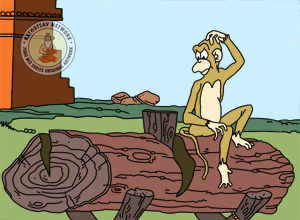
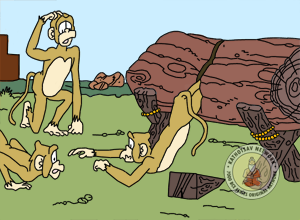
The Monkey And The Wedge - Panchatantra Story PictureThe Monkey And The Wedge - Panchatantra Story Picture


There was once a merchant who employed many carpenters and masons to build a temple in his garden. Regularly, they would start work in the morning;
and take a break for the mid-day meals, and return to resume work till evening.

One day, a group of monkey arrived at the site of the building and watched the workers leaving for their mid-day meals.

One of the carpenters was sawing a huge log of wood. Since, it was only half-done; he placed a wedge in between to prevent the log from closing up. He then went off along with the other workers for his meal.

When all the workers were gone, the monkeys came down from the trees and started jumping around the site, and playing with the instruments.

There was one monkey, who got curious about the wedge placed between the log. He sat down on the log, and having placed himself in between the half-split log, caught hold of the wedge and started pulling at it.

All of a sudden, the wedge came out. As a result, the half-split log closed in and the monkey got caught in the gap of the log.

As was his destiny, he was severely wounded.

The wise indeed say:
One, who interferes in other's work, surely comes to grief.

Mark Zuckerberg

Mark Zuckerberg is co-founder and CEO of the social-networking website Facebook, as well as one of the world's youngest billionaires.

Who Is Mark Zuckerberg?

Born on May 14, 1984, in White Plains, New York, Mark Zuckerberg co-founded the social-networking website Facebook out of his college dorm room. He left Harvard after his sophomore year to concentrate on the site, the user base of which has grown to more than 2 billion people, making Zuckerberg a billionaire. The birth of Facebook was portrayed in the 2010 film The Social Network.

Early Life

Mark Elliot Zuckerberg was born on May 14, 1984, in White Plains, New York, into a comfortable, well-educated family, and raised in the nearby village of Dobbs Ferry. His father, Edward Zuckerberg, ran a dental practice attached to the family's home. His mother, Karen, worked as a psychiatrist before the birth of the couple's four children—Mark, Randi, Donna and Arielle.
Zuckerberg developed an interest in computers at an early age; when he was about 12, he used Atari BASIC to create a messaging program he named "Zucknet." His father used the program in his dental office, so that the receptionist could inform him of a new patient without yelling across the room. The family also used Zucknet to communicate within the house. Together with his friends, he also created computer games just for fun. "I had a bunch of friends who were artists," he said. "They'd come over, draw stuff, and I'd build a game out of it."
To keep up with Mark's burgeoning interest in computers, his parents hired private computer tutor David Newman to come to the house once a week and work with Mark. Newman later told reporters that it was hard to stay ahead of the prodigy, who began taking graduate courses at nearby Mercy College around this same time.
Zuckerberg later studied at Phillips Exeter Academy, an exclusive preparatory school in New Hampshire. There he showed talent in fencing, becoming the captain of the school's team. He also excelled in literature, earning a diploma in classics. Yet Zuckerberg remained fascinated by computers, and continued to work on developing new programs. While still in high school, he created an early version of the music software Pandora, which he called Synapse. Several companies—including AOL and Microsoft—expressed an interest in buying the software, and hiring the teenager before graduation. He declined the offers.

Time at Harvard

After graduating from Exeter in 2002, Zuckerberg enrolled at Harvard University. By his sophomore year at the ivy league institution, he had developed a reputation as the go-to software developer on campus. It was at that time that he built a program called CourseMatch, which helped students choose their classes based on the course selections of other users. He also invented Facemash, which compared the pictures of two students on campus and allowed users to vote on which one was more attractive. The program became wildly popular, but was later shut down by the school administration after it was deemed inappropriate.
Based on the buzz of his previous projects, three of his fellow students—Divya Narendra, and twins Cameron and Tyler Winklevoss—sought him out to work on an idea for a social networking site they called Harvard Connection. This site was designed to use information from Harvard's student networks in order to create a dating site for the Harvard elite. Zuckerberg agreed to help with the project, but soon dropped out to work on his own social networking site with friends Dustin Moskovitz, Chris Hughes and Eduardo Saverin.
Zuckerberg and his friends created a site that allowed users to create their own profiles, upload photos, and communicate with other users. The group ran the site—first called The Facebook—out of a dorm room at Harvard until June 2004. After his sophomore year, Zuckerberg dropped out of college to devote himself to Facebook full time, moving the company to Palo Alto, California. By the end of 2004, Facebook had 1 million users.

The Rise of Facebook

In 2005, Zuckerberg's enterprise received a huge boost from the venture capital firm Accel Partners. Accel invested $12.7 million into the network, which at the time was open only to ivy league students. Zuckerberg's company then granted access to other colleges, high school and international schools, pushing the site's membership to more than 5.5 million users by December 2005. The site then began attracting the interest of other companies, who wanted to advertize with the popular social hub. Not wanting to sell out, Zuckerberg turned down offers from companies such as Yahoo! and MTV Networks. Instead, he focused on expanding the site, opening up his project to outside developers and adding more features.
Zuckerberg seemed to be going nowhere but up, however in 2006, the business mogul faced his first big hurdle. The creators of Harvard Connection claimed that Zuckerberg stole their idea, and insisted the software developer needed to pay for their business losses. Zuckerberg maintained that the ideas were based on two very different types of social networks but, after lawyers searched Zuckerberg's records, incriminating Instant Messages revealed that Zuckerberg may have intentionally stolen the intellectual property of Harvard Connection and offered Facebook users' private information to his friends.
Zuckerberg later apologized for the incriminating messages, saying he regretted them. "If you're going to go on to build a service that is influential and that a lot of people rely on, then you need to be mature, right?" he said in an interview with The New Yorker. "I think I've grown and learned a lot."
Although an initial settlement of $65 million was reached between the two parties, the legal dispute over the matter continued well into 2011, after Narendra and the Winklevosses claimed they were misled in regards to the value of their stock.
Zuckerberg faced yet another personal challenge when the 2009 book The Accidental Billionaires, by writer Ben Mezrich, hit stores. Mezrich was heavily criticized for his re-telling of Zuckerberg's story, which used invented scenes, re-imagined dialogue and fictional characters. Regardless of how true-to-life the story was, Mezrich managed to sell the rights of the tale to screenwriter Aaron Sorkin, and the critically acclaimed film The Social Network received eight Academy Award nominations.
Zuckerberg objected strongly to the film's narrative, and later told a reporter at The New Yorker that many of the details in the film were inaccurate. For example, Zuckerberg had been dating longtime girlfriend Priscilla Chan, a Chinese-American medical student he met at Harvard, since 2003. He also said he never had interest in joining any of the final clubs. "It's interesting what stuff they focused on getting right; like, every single shirt and fleece that I had in that movie is actually a shirt or fleece that I own," Zuckerberg told a reporter at a start-up conference in 2010. "So there's all this stuff that they got wrong and a bunch of random details that they got right."
Yet Zuckerberg and Facebook continued to succeed, in spite of the criticism. Time magazine named him Person of the Year in 2010, and Vanity Fair placed him at the top of their New Establishment list. Forbes also ranked Zuckerberg at No. 35—beating out Apple CEO Steve Jobs—on its "400" list, estimating his net worth to be $6.9 billion.

Philanthropic Causes

Since amassing his sizeable fortune, Zuckerberg has used his millions to fund a variety of philanthropic causes. The most notable examples came in 2010. In September of that year, he donated $100 million to save the failing Newark Public Schools system in New Jersey. Then, in December 2010, Zuckerberg signed the "Giving Pledge", promising to donate at least 50 percent of his wealth to charity over the course of his lifetime. Other Giving Pledge members include Bill Gates, Warren Buffett and George Lucas. After his donation, Zuckerberg called on other young, wealthy entrepreneurs to follow suit. "With a generation of younger folks who have thrived on the success of their companies, there is a big opportunity for many of us to give back earlier in our lifetime and see the impact of our philanthropic efforts," he said.

Going Public

Zuckerberg made two major life changes in May 2012. Facebook had its initial public offering, which raised $16 billion, making it the biggest internet IPO in history. How Zuckerberg's company will handle this influx of cash remains to be seen. But Zuckerberg may be looking at more acquisitions. He personally negotiated the company deal to buy Instragram the previous month.
After the initial success of the IPO, the Facebook stock price dropped somewhat in the early days of trading, though Zuckerberg is expected to weather any ups and downs in his company's market performance.

Family Life and Personal

On May 19, 2012—a day after the IPO—Zuckerberg wed his longtime girlfriend, Priscilla Chan. About 100 people gathered at the couple's Palo Alto, California home. The guests thought they were there to celebrate Chan's graduation from medical school, but instead they witnessed Zuckerberg and Chan exchange vows. In May 2013, Facebook made the Fortune 500 list for the first time—making Zuckerberg, at the age of 28, the youngest CEO on the list.
In November 2015, Zuckerberg and Chan welcomed a daughter, Max, and Zuckerberg announced he would be taking two months of paternity leave to spend with his family. He and his wife also pledged in an open letter to their daughter that they would give 99 percent of their Facebook shares to charity. "We are committed to doing our small part to help create this world for all children," the couple wrote in the open letter that was posted on Zuckerberg's Facebook page. "We will give 99% of our Facebook shares — currently about $45 billion — during our lives to join many others in improving this world for the next generation."
In September 2016, Zuckerberg and Chan announced that the Chan Zuckerberg Initiative (CZI), the company into which they put their Facebook shares, would invest at least $3 billion into scientific research over the next decade to help “cure, prevent and manage all diseases in our children's lifetime." Renowned neuroscientist Cori Bargmann of The Rockefeller University, was named the president of science at CZI.
They also announced the founding of Chan Zuckerberg Biohub, a San Francisco-based independent research center that will bring together engineers, computer scientists, biologists, chemists and others in the scientific community. A partnership between Stanford University, University of California, San Francisco, and University of California, Berkeley, Biohub will receive initial funding of $600 million over 10 years.
In March 2017, Zuckerberg and Chan announced on Facebook that they were expecting their second child. Daughter August was born on August 28.
The CEO has undertaken a personal challenge at the start of every year since 2009, with previous efforts including learning to speak Mandarin and only eating meat he had killed himself. 

Fake News and Cambridge Analytica Scandal

After enduring criticism for the proliferation of fake news posts on his site leading up to the 2016 U.S. presidential election, Zuckerberg in early 2018 announced his personal challenge to develop improved methods for defending Facebook users from abuse and interference by nation-states.
"We won't prevent all mistakes or abuse, but we currently make too many errors enforcing our policies and preventing misuse of our tools," he wrote on his Facebook page. "If we're successful this year then we'll end 2018 on a much better trajectory."
However, Zuckerberg came under fire again a few months later when it was revealed that Cambridge Analytica, a data firm with ties to President Donald Trump’s 2016 campaign, had used private information from approximately 87 million Facebook profiles without the social network alerting its owners. The resulting outcry seemed to shake investors' confidence in Facebook, its shares dropping by 15 percent after the news became public.
Following a few days' silence, Zuckerberg surfaced on various outlets to explain how the company was taking steps to limit third-party developers' access to user information, and said he would be happy to testify before Congress. On Sunday, March 25, Facebook took out full-page ads in seven British and three American newpapers, penned in the form of a personal apology from Zuckerberg. He promised the company would investigate all of its apps, and remind users which ones they can shut off. "I’m sorry we didn’t do more at the time," he wrote. "I promise to do better for you."
Amid increasing calls for his resignation from investor groups, Zuckerberg traveled to Capitol Hill and met with lawmakers ahead of his two-day testimony, scheduled for April 10 and 11. The first day of hearings, with the Senate Commerce and Judiciary Committees, was considered a tame affair, with some senators seemingly grasping to understand the business model that powered the social media giant.
However, the follow-up hearing before House Energy and Commerce Committee proved far testier, as its members grilled the Facebook CEO over privacy concerns. During the day's testimony, Zuckerberg revealed that his personal information was among the data harvested by Cambridge Analytica, and suggested that legal regulation of Facebook and other social media companies was "inevitable."

Bernard Arnault

Bernard Arnault
French businessman
Bernard Arnault, (born March 5, 1949, Roubaix, France), French businessman best known as the chairman and CEO of the French conglomerate LVMH Moët Hennessy Louis Vuitton SA, the largest luxury-products company in the world.
Arnault graduated from the École Polytechnique in Paris with a degree in engineering. In 1971 he took control of his father’s construction firm Ferret-Savinel. Eight years later he changed the company’s name to Férinel Inc. and shifted its focus to real estate.
With $15 million of his own money, Arnault, together with Antoine Bernheim, a managing partner of the French bank Lazard Frères and Co., raised the $80 million necessary to purchase Boussac Saint-Frères, a bankrupt textile company that owned the fashion house of Christian Dior. Then, in 1987, Arnault was invited to invest in LVMH by the company’s chairman, Henri Racamier. Investing through a joint venture with Guinness PLC, Arnault ousted Racamier in 1990 and started to sweep a slew of fashion companies into the LVMH fold: Christian Lacroix, Givenchy, and Kenzo; the leather goods companies Loewe, Céline, and Berluti; the jeweler Fred Joailler; the DFS group (the world’s biggest duty-free chain); and the beauty retailer Sephora.
Arnault was known in Europe as the man who revitalized French couture in 1995 by appointing British fashion designer John Galliano to replace the venerable Hubert de Givenchy at the latter’s Paris fashion house. The “Pope of Fashion,” as Arnault was dubbed by Women’s Wear Daily, a year later moved Galliano to Christian Dior and appointed the brash British fashion designer Alexander McQueen to replace him. Arnault then hired Marc Jacobs, a young American designer, to the post of creative director at Louis Vuitton, a maker of luxury leather goods. By the early 21st century, Arnault’s fashion foresight had revived interest in these traditional fashion houses.
In 2007 Arnault was named Commander of the Legion of Honour, France’s highest order. The same year, he was featured in Time magazine’s annual Time 100 issue as one of the 100 most influential people in the world.

Jack Ma


Introduction to Jack Ma Biography

Jack Ma biography or success story could be the most inspirational thing for the new upcoming youngsters who want to be an entrepreneur.  Jack Ma biography includes many ups and downs as he faced many failures in his early life to be a successful entrepreneur. Jack Ma is included in the world’s biggest entrepreneur.
Jack Ma is the owner and chief executive officer (CEO) of world’s biggest online portal known as Alibaba. Jack Ma Alibaba is also included in the stock exchange due to its worth of shares. Jack Ma biography couldn’t be completed without Alibaba as it’s one of the biggest achievement of jack ma.
The core reason which makes jack ma the world’s well-known businessman is also due to Alibaba. Jack Ma net worth is more than 40 million USD, and this makes him the richest businessman in China. He is also listed as Asia’s top business personalities.
Jack Ma quotes  that: “If you never give up means you still have a chance, giving up is the greatest failure”

Early Life of Jack Ma Biography

Jack Ma biography turns out to be extraordinary but has many sufferings in his early life when he was trying to follow his dreams. In his early life, jack ma wasn’t good at education, he has faced many failures after which he managed to get up due to his commitment to his work. Jack ma was not financially good in his early life.
early life of jack ma biography
He believed in moving up after facing every failure he faced. So, no one would complain of fewer resources of opportunity, and he believed in keep sticking to your goals to achieve them.
Jack Ma once quoted that: “If today is hard tomorrow will be worst, but the day after tomorrow there will be sunshine”

Failures of Jack Ma Biography

We feel disgraced on facing the failures in our life, but the man life Alibaba Jack ma is the inspiration who never give up in his life after facing numerous failures. Jack Ma biography is full of failures he faced during his struggle to be a successful businessman. Some of the failures of his biography are summed up here.
failures in jack ma biography
As he quoted that:“if you never give up, means you still have a chance”

Education in Jack Ma Biography

Jack ma was failed to get the admission in the college for two times and the third time he passed with grace marks only. After completing his higher education from Cheung Kong Graduate School of Business he wanted to get admission in Harvard and failed almost 10 times.
He further included that he got 1 mark out of 120 in school examination, he was failed in his school life two times.

Professional Career in Jack Ma Biography

Jack Ma Alibaba found the setbacks as an opportunity in his life, as he was rejected for more than 30 job postings. After being rejected from all the jobs he applied for he had no other choice except to serve as an English teacher for which he was paid only 10 pounds which were not more than 10 USD

Achievements in Jack Ma Alibaba life

Jack Ma Alibaba life is full of tremendous achievements in his professional career. Some of the achievements are listed down below.
jack ma achievement
  1. In the year 2004, he was listed in Top 10 Business leaders of the year announced by China central television.
  2. In the year 2014 jack ma Alibaba was included in the world’s powerful personalities, by the globally renowned magazine Forbes.
  3. Jack Ma Alibaba also appeared in the time magazine 100 most influential people of the world.
  4. He also won the Entrepreneur of the year award at the Asian awards which were held in the year 2015.
If you want to read related articles on success stories you can visit click here. story2in helps you to view the success stories of famous personalities to motivate you in your professional career.